
Lower Back Pain Explained: Why Strength and Movement Are Part of the Solution

Lower back pain is one of the most common reasons people seek care — yet it remains one of the most misunderstood. Many people are told to “protect their back,” “avoid bending,” or “rest,” when in fact research shows that staying active and building strength are central to recovery.
At Unity Health & Performance, we take an evidence-based approach that blends clinical assessment with movement education. Understanding why pain occurs — and how movement helps — is key to rebuilding both confidence and capacity.
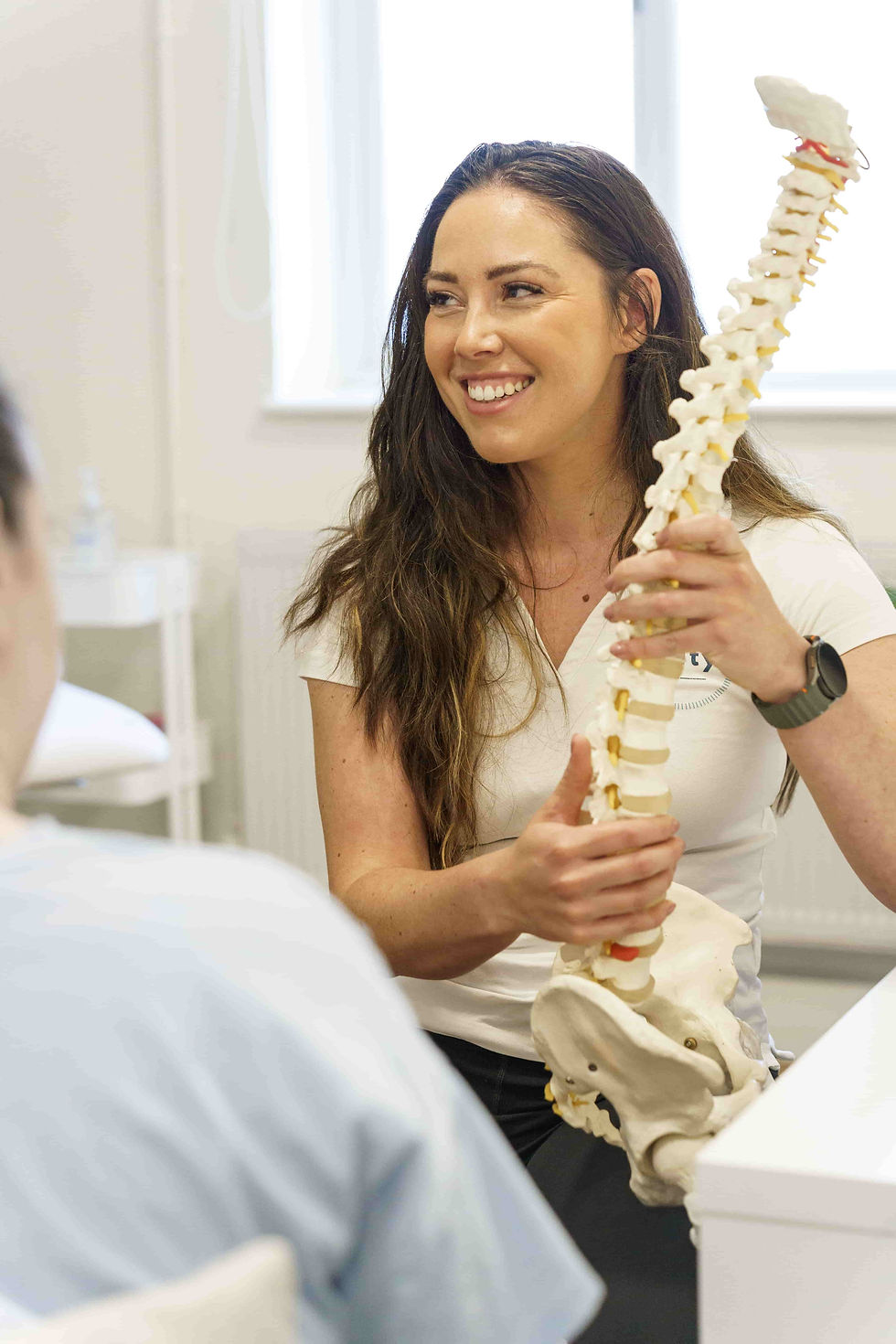
Understanding Lower Back Pain
The term “lower back pain” covers a wide spectrum of experiences. It can come on suddenly after lifting or twisting, or develop gradually from long hours sitting or repetitive strain. In most cases, it is non-specific, meaning there isn’t one damaged structure to “fix.” Instead, it reflects how your body is tolerating load, posture, and movement over time.
This is important: most back pain is not due to structural damage. NICE (2020) reports that around 85–90% of cases improve with conservative, movement-based management. Pain often reflects sensitivity, not injury — and that means it can be reversed through gradual, confident reloading.
Pain Does Not Always Mean Damage
It’s natural to assume pain equals harm, but imaging research tells a different story.
Disc bulges, facet changes, and mild degeneration are common findings, even in people without pain (Brinjikji et al., 2015).
The nervous system can become sensitised, making normal movements feel threatening or uncomfortable.
This sensitivity often improves when movement and strength are gradually restored.
When people understand that their spine is strong and adaptable, they tend to move better — and pain often reduces as a result.
Why Movement Matters
Movement is essential for spinal health. It keeps joints nourished, maintains blood flow, and helps desensitise the nervous system. Long periods of rest or avoidance can have the opposite effect, causing stiffness, muscle deconditioning, and slower recovery (Balagué et al., 2012).
Gentle, progressive movement encourages:
Improved mobility and flexibility
Better tissue health and circulation
Gradual restoration of load tolerance
Greater confidence in day-to-day activities
You don’t need to force it or “push through” pain — the goal is simply to keep moving safely and consistently within your limits.
The Importance of Strength
Once pain starts to settle, strength becomes the next step. The spine is designed for load, and building strength around it provides long-term protection. Strong muscles help distribute forces efficiently, support posture, and reduce recurrence of pain.
Research shows that strength and motor control exercises are among the most effective strategies for preventing future episodes of back pain (Steffens et al., 2016). Strength doesn’t just mean lifting weights; it means improving how your body moves, stabilises, and adapts to everyday demands.

Seeing the Whole Picture
Back pain is rarely just physical. Factors such as sleep, stress, recovery habits, and work environment all influence how the body perceives and responds to pain. This is known as the biopsychosocial model, which recognises that the body, mind, and environment all contribute to recovery.
Effective management therefore includes:
A clear clinical assessment to rule out serious causes
Education that builds understanding rather than fear
Gradual reintroduction of movement and strength
Strategies that address lifestyle and recovery
This integrated model — combining physiotherapy, osteopathy, and sports rehabilitation — aligns with NICE (2020) guidance and reflects Unity’s blended approach to long-term care.
When to Seek Professional Advice
Although most back pain improves naturally, it’s important to seek assessment if you notice:
Pain that persists or worsens over several weeks
Numbness, tingling, or weakness in the legs
Pain accompanied by fever, unexplained weight loss, or changes in bladder or bowel control
These symptoms require further investigation to rule out nerve or systemic involvement.
Key Takeaway
Lower back pain is rarely a sign of something “broken.” It’s often the body’s way of signalling that movement capacity or load tolerance needs rebuilding.
Safe, progressive movement and strength training help restore that capacity, reduce sensitivity, and prevent future flare-ups. When approached with the right guidance, strength isn’t the cause of pain — it’s the cure.
References
Balagué, F., Mannion, A. F., Pellisé, F. & Cedraschi, C. (2012). “Non-specific Low Back Pain.” The Lancet, 379(9814), 482–491.
Brinjikji, W. et al. (2015). “Systematic Literature Review of Imaging Features of Spinal Degeneration in Asymptomatic Populations.” American Journal of Neuroradiology, 36(4), 811–816.
NICE (2020). “Low Back Pain and Sciatica in Over 16s: Assessment and Management.” National Institute for Health and Care Excellence.
Steffens, D. et al. (2016). “Prevention of Low Back Pain: Systematic Review and Meta-Analysis of Controlled Trials.” JAMA Internal Medicine, 176(2), 199–208.


Comments